
A Quiet Corner with a Longer Story
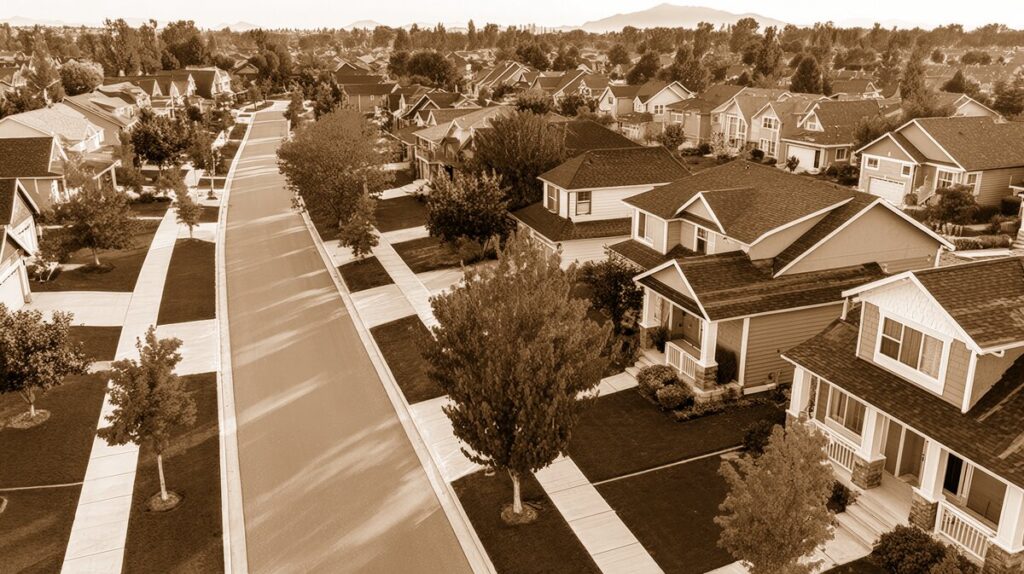
The Woods is one of those Granite Bay neighborhoods that feels established the moment you enter it. Along Chelshire Downs Road, Elmhurst Drive, and nearby residential lanes, mature trees soften the view of large homes and generous lots. The streets are quiet, the landscaping is well established, and there is a sense that the neighborhood has been here longer than many of its houses actually have.
That feeling is part of The Woods’ appeal. Although most of the neighborhood’s homes date from the early-to-mid 1990s, its character reaches much farther back—to the oak-studded hills, ranch parcels, orchards, and mining history that shaped Granite Bay long before modern subdivisions appeared.
Before The Woods: Granite Bay’s Rural Roots
The land now associated with The Woods was once part of a broader rural landscape along the American River. In the Gold Rush era, the area was known in part as Granite Bar, a mining settlement near the river. Miners worked the banks and ravines, while roads such as the old Auburn-Sacramento Road—today’s Auburn-Folsom Road—connected scattered settlements with Auburn and Folsom.
Water was central to the area’s development. The North Fork Ditch, built in the 1850s, helped support mining and later agriculture. As mining declined, families turned to ranching and farming. Olive, almond, peach, pear, and plum orchards became familiar features of the countryside. Cattle operations also occupied large stretches of land, including properties associated with early local ranchers.
Those working landscapes left a lasting imprint. Granite Bay’s rolling terrain, granite outcroppings, open fields, and mature valley oaks continue to define the community. The Woods was built during a period when developers were transforming former rural acreage into residential neighborhoods, but the homes were designed around the land rather than completely erasing it.
How The Woods Got Its Name
The neighborhood’s name appears to be a straightforward reflection of its setting. Unlike Granite Bay itself, whose name is tied to local granite and the shoreline of Folsom Lake, The Woods does not seem to have a widely documented namesake or single founding story.
Instead, the name captures what residents and visitors notice first: the wooded atmosphere. The neighborhood’s larger parcels, mature trees, natural drainage areas, and leafy streets distinguish it from denser suburban developments nearby. Real estate and county property records identify the subdivision as The Woods, while local descriptions often place it within the larger Treelake area.
It is worth remembering that subdivision names in Granite Bay often describe an experience as much as a legal boundary. “The Woods” communicates privacy, shade, and a connection to the older landscape. Even as homes have been remodeled and gardens have matured, that original impression remains.
The Granite Bay Turning Point
The modern history of The Woods is closely connected to Granite Bay’s transition from rural crossroads to established residential community.
Folsom Lake, created by the completion of Folsom Dam in the 1950s, changed the area’s geography and economy. Former ranch and river lands became associated with recreation, boating, fishing, and lake access. Granite Bay Beach and the Granite Bay entrance to Folsom Lake State Recreation Area helped make the eastern Placer County countryside attractive to families seeking more space without moving far from Sacramento.
Another important milestone came in 1962, when John Mercurio and Louis Gavino developed Granite Bay Vista, one of the area’s early residential subdivisions. The project helped popularize the Granite Bay name at a time when the region was still sometimes described as part of Roseville or simply as the area near Folsom Lake.
On July 28, 1987, Placer County officially recognized Granite Bay as an unincorporated community. Two years later, the first Granite Bay Community Plan was adopted. That plan encouraged orderly growth while protecting the area’s rural-residential character, open space, trees, and scenic qualities. These decisions helped shape the kind of development that eventually produced neighborhoods such as The Woods.
The Neighborhood Takes Shape
The Woods emerged during the residential growth of the early 1990s. Available housing records place many of its homes between roughly 1993 and 1995, making the neighborhood a product of the era when Granite Bay was filling in between older ranch properties and newer master-planned communities.
The homes were generally larger than those in conventional suburban tracts, with many sitting on lots of approximately one-third to one-half acre or more. California ranch, traditional, and Mediterranean-inspired designs became common, often with tile roofs, stucco exteriors, broad driveways, pools, and substantial backyards.
Chelshire Downs Road serves as one of the neighborhood’s best-known addresses, while nearby streets and connections toward Eureka Road and Roseville Parkway help place The Woods within the broader Granite Bay road network. Some sections have private or semi-private characteristics, reinforcing the neighborhood’s quieter, more residential feel.
The mature landscaping seen today was not an overnight achievement. Over the decades, newly planted street trees and backyard plantings grew into the canopy that now gives The Woods its name-like atmosphere. In many places, the architecture has become visually secondary to the trees, lawns, and natural edges.
Landmarks and Places That Shape Local Life
The Woods does not have a historic courthouse, railroad depot, or preserved Gold Rush building at its center. Its heritage is more subtle and connected to the surrounding community.
- Treelake Village Park provides fields, courts, playgrounds, picnic areas, and everyday gathering space for nearby families.
- Ronald L. Feist Park is another important recreational landmark, with sports fields, tennis facilities, open space, and room for community activities.
- Eureka Union School District schools, including Oakhills Elementary and Cavitt Junior High, have helped anchor family life in the area for decades.
- Folsom Lake and Granite Bay Beach remain the community’s most recognizable natural landmarks, offering a reminder that the neighborhood grew beside a recreational landscape as well as former ranchland.
- Miners Ravine and nearby open-space corridors preserve traces of the region’s natural drainage, wildlife habitat, and mining-era terrain.
These places are part of what makes The Woods feel connected rather than isolated. Residents may live on quiet residential streets, but parks, schools, trails, shopping, and the lake are all woven into the daily rhythm of Granite Bay.
The Woods Today
Today, The Woods has entered a new phase. The original homeowners have been joined by second-generation residents, longtime families have remodeled or expanded their properties, and some homes have changed hands while retaining the neighborhood’s established character.
The central appeal remains remarkably consistent: privacy without isolation, generous lots without true rural remoteness, and a leafy setting close to schools, parks, Douglas Boulevard, Roseville, and Folsom Lake.
What makes The Woods special is not one dramatic landmark or a single defining event. Its heritage is cumulative. It is found in the old oak trees, the former orchard country, the memory of Granite Bay’s ranching years, the careful growth that followed the 1987 community designation, and the families who have cared for these streets since the 1990s.
For longtime residents, The Woods is more than a subdivision name. It is a reminder that even in a growing community, a neighborhood can preserve the feeling of the land that came before it.